
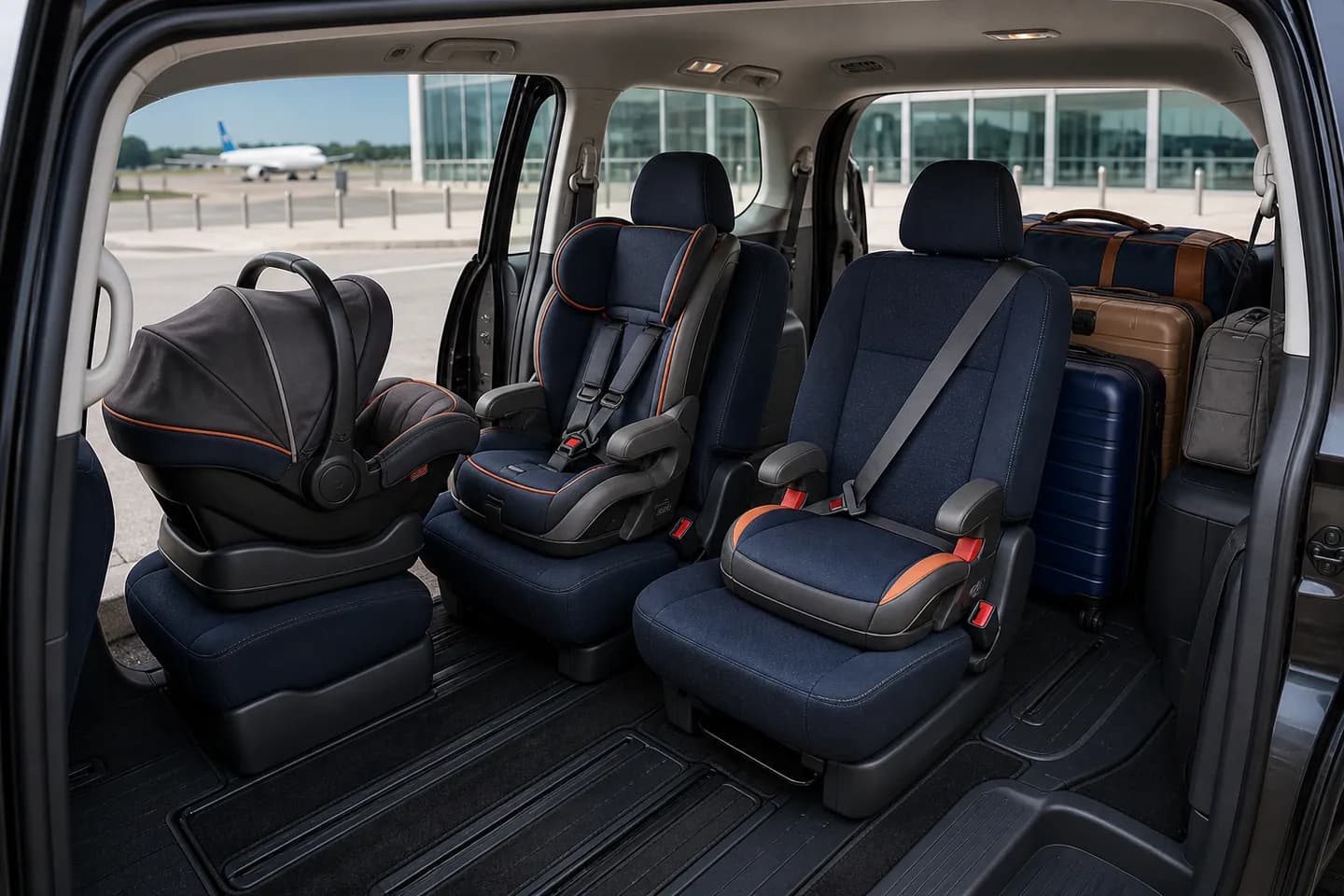
You can book a Disneyland transfer with a rear-facing infant seat at no extra cost, but you need to request it at booking and give your baby’s age, weight and length. Under the current European i-Size rules followed in France, babies must travel rear-facing until at least 15 months, and many parents choose to keep toddlers rear-facing for longer. That matters because some seat guides still describe forward-facing seats from nine months. Telling us the exact figures lets the driver bring a rear-facing seat that fits now rather than one chosen by age alone. This guide explains seat types, placement in the car, and how to handle a buggy and baby kit on the same journey.
What this guide answers
Seat type, age/weight and booking requirements
Quick facts
- Rear-facing rule
- Until at least 15 months
- Seat cost
- Free with every booking
- Request when
- At booking, in the notes
- Give us
- Age, weight and length
- Best position
- Rear seat
- Works from
- CDG, Orly, Beauvais, Paris
Infant carrier or rear-facing toddler seat?
Babies in their first year usually travel in an infant carrier, a shell seat with a carry handle that faces backwards. As they grow longer, they move into a larger rear-facing seat that stays in the car and gives more leg room while still facing the rear.
There is no single cut-off date for the switch: it depends on the seat’s approval label and your baby’s length and weight. That is why we ask for real measurements. A ten-month-old who is long for their age may already need the larger seat.
What the 15-month rule means in practice
Newer i-Size seats approved under the R129 standard require rear-facing travel until at least 15 months. Older seats approved under the previous standard allowed forward-facing from nine kilograms, which is why you will still find guides and even some websites suggesting earlier forward-facing.
If your child is between about 12 and 18 months, write "rear-facing please" next to their details. That removes any doubt and makes sure a seat that faces backwards is fitted, rather than a forward-facing toddler seat chosen by age range.
Requesting the seat correctly: step by step
Step 1 — Count the baby as a passenger when you enter the party size in the booking tool, even though they will not take an adult seat.
Step 2 — In the notes, write the seat you need, for example "rear-facing infant seat, baby 8 months, 8.5 kg, 70 cm".
Step 3 — Add the buggy, car-seat bag and any travel cot to your luggage list so the vehicle has room for them.
Step 4 — Check the confirmation mentions the rear-facing seat. If it does not, reply in writing before your travel date. On the day, look at the fitting before you strap your baby in and ask the driver if anything seems loose.
Where the seat goes and why
The rear seat is the normal place for a rear-facing seat. It can only go in front if the passenger airbag is switched off, because an airbag opening into the back of the shell is dangerous. Drivers generally prefer to keep babies behind the front seats.
Sitting an adult next to the baby makes feeding and settling easier. If you are travelling with older children as well, a van with two rear rows gives space for everyone without squeezing the rear-facing seat between boosters.
Bringing your own carrier versus using ours
Some parents bring their own infant carrier because the baby is used to it or it clips into their pushchair. That is fine; tell us at booking so the driver does not fit a second seat in the same position, and allow a few minutes at arrivals to install it securely.
Using the seat provided saves carrying a bulky shell through the airport. Seats are prepared before your driver arrives, so on most pick-ups you only need to lift your baby in and adjust the harness to their clothing.
Rear-facing seats on other ways to reach the parks
On the RER or a coach such as the Magical Shuttle your baby travels on your lap or in a sling, with no car seat needed but also no restraint. The journey includes station changes or several hotel stops, which can be tiring with a pushchair.
App-based ride services seldom guarantee an infant seat. A pre-booked Disneyland Paris taxi with a confirmed rear-facing seat is the most predictable option for a newborn or young baby; you can check the fare in the live booking tool before deciding.
Plan the next step
What travellers say on Google
5.0/5from 57 Google reviews (as of 18 October 2026)
“Excellent communication through WhatsApp pre arrival. Picked up in arrivals by driver with names clearly displayed. The vehicle was very large and very comfortable. There was a movie on for my kids who enjoyed that during the ride to Disneyland. The return trip was just as good. Excellent service.”
Paul Murphy · Google review
“Great experience, picked up in a spacious luxury van with comfortable seats, A/C and big screen TV for the kids, meet and greet service on arrival and underground parking drop off at the station to give ample time to empty van and get the lift up to platforms. Definitely recommend and use again in future!”
Guillaume Bayrou · Google review
“A fantastic service. Waiting for us at the airport and at the hotel. Drivers were very friendly, professional and accommodating. Spotless clean vehicle, and a tv showing a movie was a massive surprise for the kids. I would highly recommend them and would defo use them again. Very good price, and hard to beat it.”
Graham Hillick · Google review
Frequently asked questions
Is a rear-facing seat available on every route?
Rear-facing seats can be requested on transfers from CDG, Orly, Beauvais, Paris hotels and train stations to Disneyland Paris, and on the return. The important thing is to request it at booking with your baby’s measurements, so the seat is prepared before the driver sets out.
Until what age must my baby face backwards?
Under i-Size rules, until at least 15 months. Many safety organisations recommend staying rear-facing longer if the seat allows it. If your child is older than 15 months but you would like them to stay rear-facing, say so when booking and give their height and weight.
Can I carry my baby on my lap in a taxi?
Holding a baby on your lap in a moving car is not safe, as an adult cannot hold a child during sudden braking. French rules expect children under 10 to use a suitable restraint. Booking a transfer with a free infant seat removes the problem.
Will a buggy fit with the seat installed?
In most cases yes, as long as the buggy folds. List it with your suitcases when booking so the vehicle size is right. Large travel systems or twin buggies take a lot of boot space, so mention the model if you have one of those.
Does the infant seat cost extra?
No. Infant, toddler and booster seats are provided free with Disney Taxi Paris transfers. The fare is fixed and shown in the live booking tool before you confirm; requesting a seat does not change it, although choosing a larger vehicle for more passengers or luggage can.
What if the seat provided does not fit my baby properly?
Tell the driver before setting off. Giving accurate measurements at booking makes this unlikely, but a growth spurt between booking and travel can change things. If you have an updated weight or length, send it in writing a few days before the transfer.
Can a rear-facing seat go in the front passenger seat?
Only with the front airbag switched off, and the rear seat is the usual choice. Drivers prefer to place babies behind the front seats, with a parent beside them. If you need the baby in front for a medical reason, raise it in writing before booking.
Written and reviewed by Disney Taxi Paris · Updated 18 October 2026. Airline terminals, public-transport operations and venue access can change; confirm time-sensitive details before travel.